
NOX ET DIES
(Night and Day)
POETRY READINGS FOR WRITING ON THE WALL
click on an image to enlarge
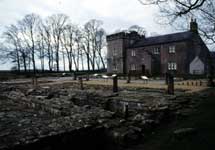
Birdoswald Roman Fort, |
 |
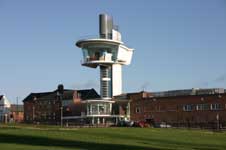
Segedunum Roman Fort, Baths & Museum |
 |
NOX ET DIES was the first public event for the International Writing project, Writing on the Wall.
The readings involved 6 UK writers: Kitty Fitzgerald, Robert Forsythe, Linda France, Bill Herbert, Peter Mortimer and Katrina Porteous – all established and well recognised writers from the counties along the wall.Each gave an introduction to their educational and community based work, and then read a selection of their own work that is connected to Hadrian’s Wall and some of the writing that has been created in the education and community workshops.
NOX ET DIES refered to the time of day that the two readings took place. It also alluded to the various characteristics of the writers’ own works and explorations – the light and dark qualities of the wall area, the simplicity and complexity of an Iconic Monument with World Heritage Status.
It is also a place where local people and communities live and develop, history is stopped and continues, Foot and Mouth first broke out and farming and tourism sit side by side.
Bill Herbert
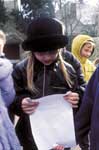
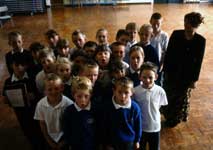
He worked with Year 5 children in Hadrian Primary School, South Shields and in Carville Primary School, Wallsend. He thinks of poetry as a means of looking afresh at the world around us, and had been looking for a way of using the Roman forts to help the children examine their sense of place and history. It occurred to him on his research visits that these children’s experiences of the forts being reconstructed had some parallels with those of the people living here at the time of the Romans’ first settlements. He encouraged them to look at the physical evidence on site both as moderns and as ancients, and enabled them to gain a new perspective on the contemporary world surrounding Arbeia and Segedunum. |
|


Kitty Fitzgerald
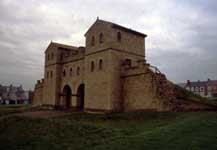
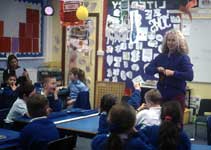 Kitty at Waberthwaite School 
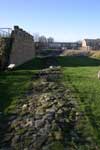
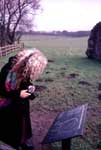 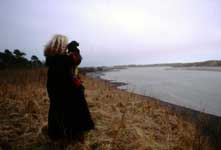 Kitty at Ravenglass |
She worked in Waberthwaite Infant & Junior School with three classes, In the first session of the community writing workshop the participants looked at different ways to use research material as the basis for creative writing. For the follow up session participants were asked to create a piece of work which they brought to the session for a reading and discussion. Kitty is presently working on a piece inspired
by the herbs the
Romans probably used over here for culinary and health purposes.
This will |
Robert Forsythe
|
Robert worked with First School children at Heddon (whose petrol station entered Auden's Hadrian's Wall piece) to explore the notions of the importance of the ordinary and who is the barbarian via Auden's work. Part of the workshops were intended to re-invigorate the pupils’ interest in their locality, which played a role in Auden’s work, but to which they have become familiar.
|
|

Linda France
|
|
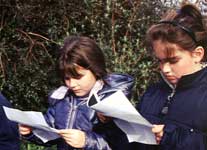
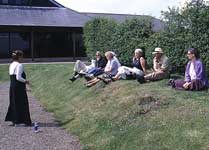
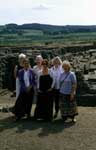
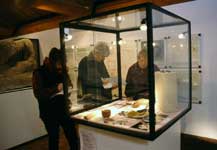
Members of the community group were invited to respond to various exhibits in the Corbridge Museum. They created their own contemporary version of 'The Corbridge Hoard'. The original was discovered in 1964 – a wooden chest buried during the first half of the second century, containing a remarkable collection of objects. They also traced the imagined origin of a selection of other 'found' objects.
|

Peter Mortimer
| Peter Mortimer is a poet, playwright and editor who writes for both adults and children, often confusing the two. As well as his verse and drama, he has penned several restless 'external' books; The Last of the Hunters detailing his six months working as a fisherman in the North Sea, Broke Through Britain - an account of his 500 mile penniless trudge from Plymouth to Edinburgh, and One Hundred Days on Holy Island, recording an entire winter spent on this isolated North-East coastal outpost. He proposed an ambitious project - to write, walk and perform a play along the length of Hadrian's Wall. Pete describes this project: "Cloud Nine The Troubadours Tour was a throwback to a lost age, just as the Roman Wall is; a band of strolling players performing a play each evening, then moving on the next morning, calling down an audience from the hills and the farms of Cumbria and Northumberland. Arriving, performing, sleeping, then onwards, from Bowness in the West to Wallsend in the East, eleven days on the hoof, responding to the natural world around them, relating to the people of this sparsely populated landscape. Drama, and music, and no two performances the same, and everywhere they go some impression left, some impression gained. And with the actors, the writer and his work, to entertain, to provoke, to shock, to involve, as we throw a band across the country.
|
Katrina Porteous
| Katrina Porteous's poetry is strongly
rooted in the landscape and culture of Northumberland where she
lives. Committed to bringing poetry into people’s everyday
lives, she has worked with both fishing and farming communities
and is currently completing her second collection for Bloodaxe.
In a culture which is increasingly urban, we look to the countryside for renewal. But what sort of countryside? Nowhere is this question more acute, or the relationship between conservation, tourism and traditional farming methods more sensitive, than along Hadrian’s Wall. Working with individual farming families and with groups such as Young Farmers and Over 60s in the Haltwhistle area of the Wall, Katrina Porteous aims to explore this delicate balance. She worked closely with local people, recording their own experiences and traditions, developing their writing, and writing poetry of her own. In particular, she encouraged individuals to express their experiences of how the Wall impacts on their lives; what problems it presents; what benefits they feel they get from it; and what particular challenges they face at the current time, in the aftermath of the foot and mouth epidemic which has so devastated this area. Tourism along the Wall depends upon traditional hill farming methods. This land has been farmed continuously for over 4,000 years: the Roman occupation constituted only a tiny fraction of that time. Farming practices continue to shape the landscape today, and the future of the area depends upon finding ways for farming, tourism and conservation to work together. Both Katrina’s work within the community and her own poetry will help to promote this understanding. |

